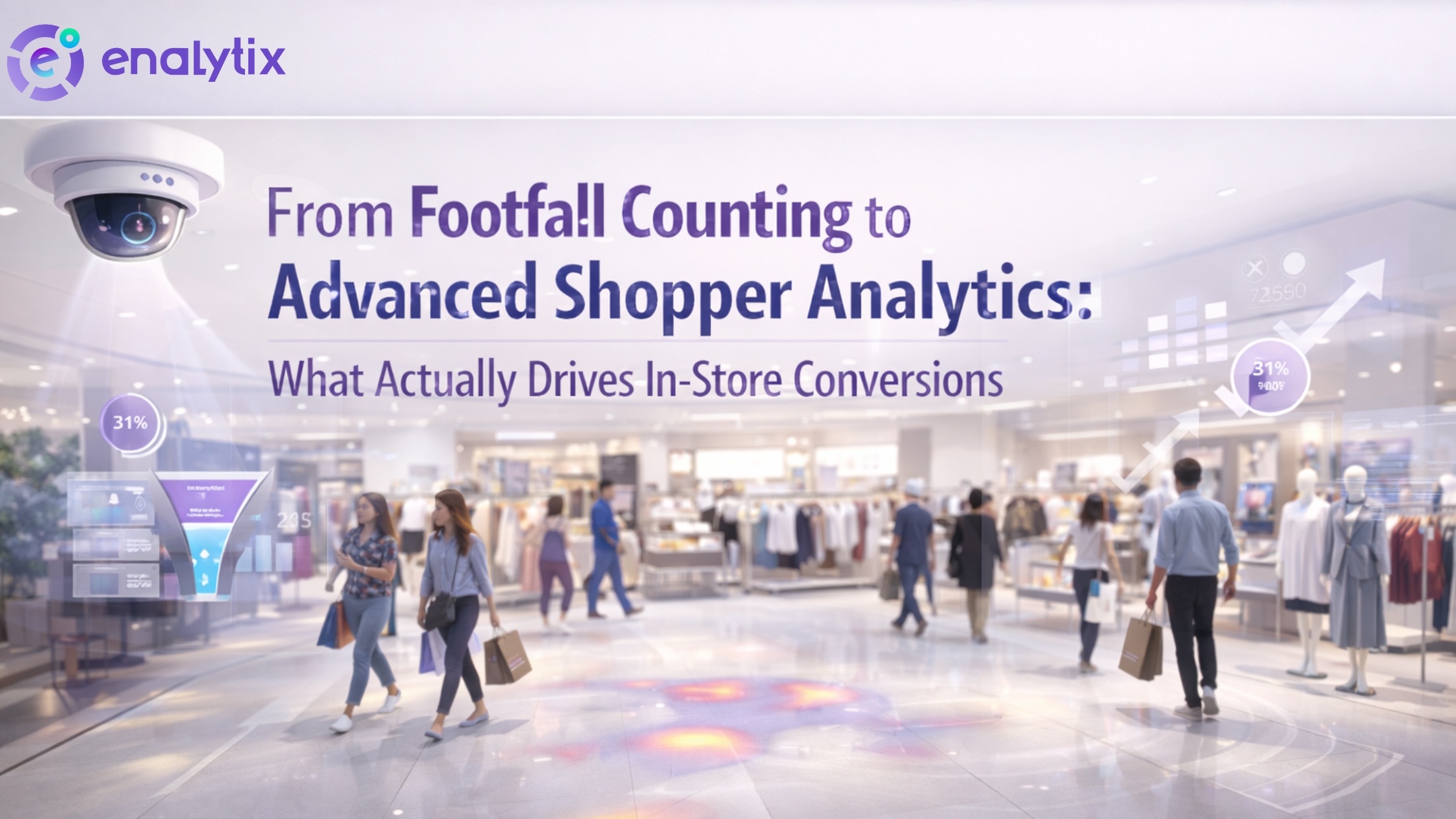
For decades, retailers have measured store performance using a simple metric: footfall. Knowing how many people entered a store was considered enough to judge success, plan staffing, and compare locations.
But retail has changed.
Today, many stores experience increasing footfall yet stagnant or declining conversions. The reason is clear: footfall tells you how many people came in—but not what made them buy. To truly drive in-store conversions, retailers must move beyond counting visitors and start understanding shopper behavior.
The transition is the beginning of moving towards advanced shopper analytics.
Footfall Counting: An Immediate Beginning, Not an End.
Footfall counters are quite significant in retail activities. They assist in the answering of simple operational questions like:
• How many visitors entered or exited the store?
• What are peak hours or high-traffic days?
• How does one store compare to another?
These revelations are great for workforce planning, as well as for making upper-tier reports. Nonetheless, footfall taking the entire data comes with a basic limitation that is stopping at the entrance. Footfall counters are incapable of shedding light on:
• Attention-getting spots in the store
• Duration of shoppers’ interaction with products
• Persons holding back, staying, or dropping their journey
• Why two outlets having the same footfall count still exhibit different sales performance
Thus, decisions that are mainly based on footfall usually depend on assumptions rather than on pieces of evidence.
The Conversion Blind Spot in Traditional Retail Analytics
Retail conversions are subject to various in-store factors like layout, visibility of goods, product position, crowds, and checkout speed. Nevertheless, when merchants only consider foot traffic, most of these factors stay hidden.
Imagine this frequent scenario: a shop ups its advertising expenditures and records an increase in foot traffic, but sales stay the same. Without behavioral insights, the teams are left making guesses:
• Are customers finding the right products?
• Are queues discouraging purchases?
• Are promotional displays actually seen?
This is the conversion blind spot created by footfall-only analytics.
Heatmaps: Where Counting Transforms into Understanding
Heatmaps are often bundled as an add-on to footfall counters, but their real value lies in what they unlock: context.
By visualizing customer movement inside the store, heatmaps reveal:
• High-traffic and low-traffic zones
• Natural movement paths and dead areas
• Dwell time across different sections
• Congestion points during peak hours
Retailers no longer have to deal with cold figures but rather a visual and dynamic comprehension of the shoppers’ activity. Heatmaps demonstrate not only the routes of the shoppers but also the places that they avoid often the most significant insight.
For example:
• A premium display may exist in a low-visibility zone
• A high-margin category may receive minimal engagement
• A congested aisle may be driving customers away faster than expected
Data-driven layout and merchandising decisions are these insights and their implementation.
Moving Beyond Heatmaps: Advanced Shopper Analytics
True shopper analytics goes beyond visualization by layering intelligence and action.
1. Dwell Time and Engagement Analytics
Dwell time is a very strong indicator of purchase intent. Advanced analytics determine the length of engagement of shoppers with the definite zones, shelves, or displays; thus, helping the retailers to spotlight what is attracting attention—and what isn’t.
2. Zone-Level Performance Insights
Studying behavior at a zone level permits the retailers to distinguish which spots boost up the engagement and which cause drop-offs. Matching it up with sales data, thus exposes the genuine contributors to conversion.
3. Shopper Flow and Path Analysis
Mapping out customer movement from the entrance to the exit helps to find out the store’s bottlenecks, neglected aisles, and layouts that are inefficient and thus, not exposing the key products to the customers.
4. Real-Time Operational Alerts
Recent analytics allow for real-time alerts to be sent out whenever there is a crowd, queue formation, or underuse of certain areas. This empowers store managers to take actions immediately, such as, adding staff, opening counters, or redirecting customer flow instead of waiting for the reports after the opportunity has gone.
What Actually Drives In-Store Conversions?
Advanced shopper analytics consistently highlight a few critical conversion drivers:
• High visibility of relevant products
• Clear, frictionless movement across the store
• Adequate dwell time in decision-making zones
• Minimal congestion and wait times
• Timely staff intervention when needed
None of these factors can be optimized through footfall data alone. They require behavioral intelligence that reflects how shoppers truly experience the store.
Enalytix: Turning Cameras into Shopper Intelligence
Enalytix helps retailers evolve from basic footfall counting to AI-powered shopper analytics using existing camera infrastructure.
Our platform enables retailers to:
• Measure footfall and heatmaps from a single system
• Gain zone-wise behavioral and dwell insights
• Monitor crowding and queue conditions in real time
• Generate actionable alerts for store teams
• Scale insights consistently across multiple locations
All analytics are delivered with a privacy-first approach, ensuring compliance while maximizing business value.
The Bottom Line
Footfall counting tells you how many people entered your store.
Advanced shopper analytics tell you what influenced their decisions.
In a competitive retail environment, conversions are driven by understanding behavior, reducing friction, and acting on real-time insights not by counting visitors alone.
The future of in-store performance lies in moving from numbers to narratives, from volume to value, and from footfall to intelligence.
Leave a Reply