Introduction
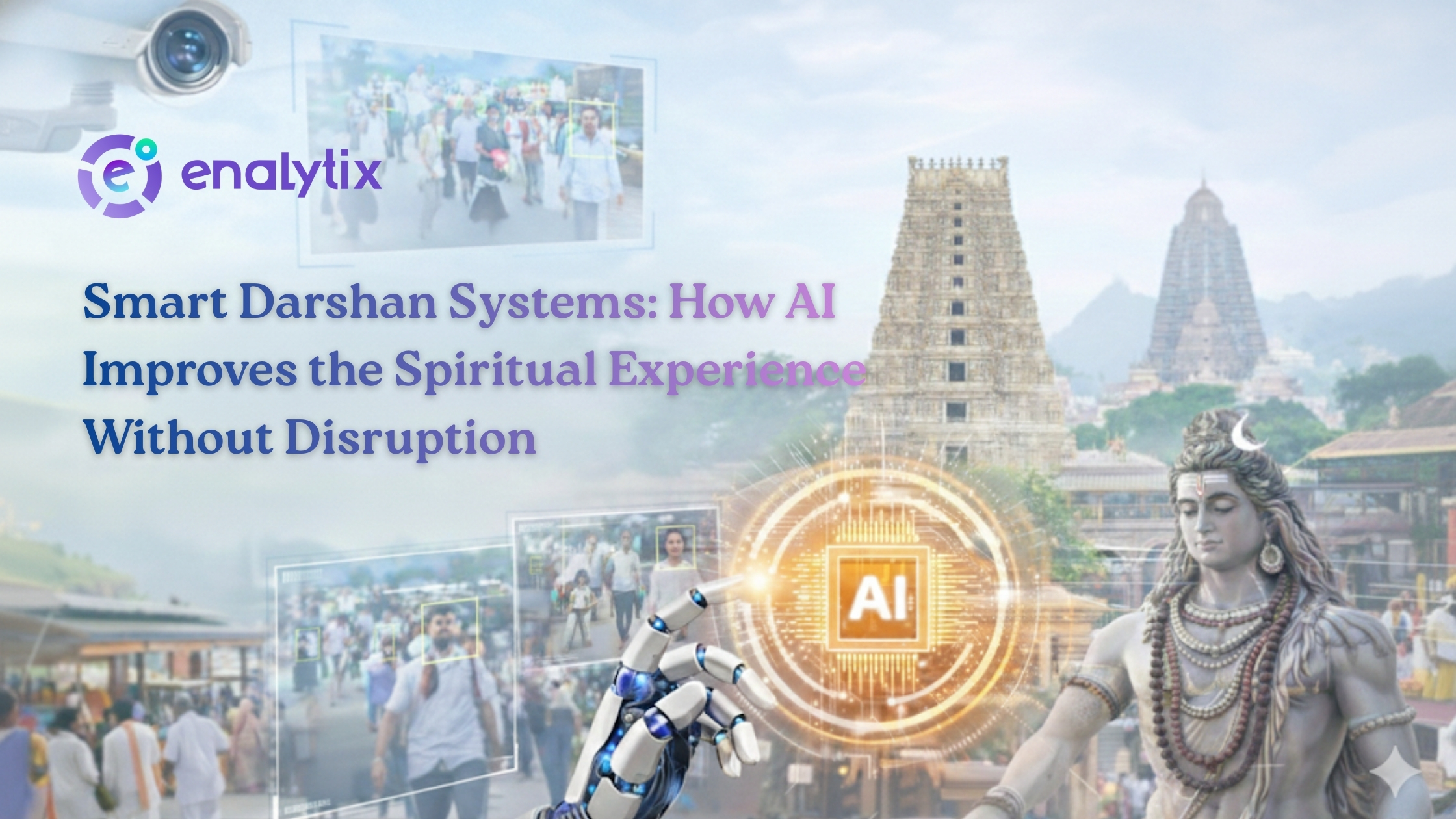
India is home to thousands of ancient temples that witness footfalls in the lakhs, and sometimes even crores, every single year. From daily rituals to massive festival surges, managing these crowds while keeping the spiritual sanctity intact has become a massive headache for temple administrations. Old-school methods like heavy barricading, manual queues, and volunteers on walkie-talkies just aren’t cutting it anymore. As the number of devotees grows, balancing safety with a peaceful atmosphere is getting tougher. This is exactly where Smart Darshan Systems step in. Using AI-driven analytics, these systems refine the entire experience without ever touching the traditions or the privacy of the devotees.
Growing Crowd Management Challenges in Temples
Modern temples face a unique operational reality:
- Sudden spikes in bheed during festivals, auspicious days, or high-profile VIP visits.
- Devotees often face long, exhausting, and unpredictable waiting periods.
- Most temples have limited physical space that wasn’t built for today’s massive crowds.
- Safety risks like stampedes or crushing become real threats when queues aren’t managed well.
- A heavy reliance on manual effort, which leads to staff burnout and human error.
The problem is that most management is “reactive”—they only act once the crowd has already become unmanageable. To keep the darshan peaceful, temples need a “proactive” setup with real-time visibility.
What a Smart Darshan System Means
A Smart Darshan System isn’t about cameras watching people; it’s an intelligent framework that uses AI to understand the flow of movement. It works silently in the background so that rituals remain untouched. Key highlights include:
- Real-time visibility of how the crowd is flowing through different zones.
- Accurate estimates of queue lengths and actual waiting times.
- Pinpointing exactly where “bottlenecks” or jams are forming.
- Using data to place volunteers where they are actually needed.
- A privacy-first approach that doesn’t need to know “who” you are, just “how many” are there.
AI-Based Queue & Crowd Flow Management
At the core of a smart darshan system is AI-powered queue and crowd flow analysis.
Using computer vision and behavioral analytics, AI systems analyze live visual data to understand:
- How queues are forming and dispersing
- Where devotees slow down or stop
- Which paths experience bottlenecks
- How long devotees spend waiting at different stages
This enables temple authorities to:
- Adjust entry and exit routing dynamically
- Open or close alternative pathways
- Balance crowd distribution across halls or mandaps
- Prevent overcrowding before it becomes a risk
Unlike manual monitoring, AI continuously observes patterns and provides insights in real time, allowing proactive crowd management with AI rather than emergency response.
Reducing Wait Times Without Disturbing Rituals
One of the biggest fears is that technology might ruin the “vibe” of a temple. Smart Darshan Systems solve this by being invisible. The AI doesn’t interfere with Pujas, Aartis, or any sacred schedules. Instead, it finds the “hidden” delays in the lines. When a devotee knows exactly how long the wait is and moves through a smooth line, their stress disappears, allowing them to focus entirely on their prayers.AI does not interfere with:
- Pujas or aartis
- Temple schedules
- Religious customs
- Devotee behavior
Instead, it helps reduce waiting times by:
- Identifying inefficiencies in queue movement
- Highlighting underutilized access routes
- Supporting better volunteer positioning
- Enabling time-slot optimization during peak hours
Privacy-First, Non-Intrusive Analytics
Privacy is non-negotiable in a sacred space. Modern systems are built to be secure:
- No Facial Recognition: The system doesn’t identify individuals.
- No Personal Data: It doesn’t collect names or phone numbers.
- Pattern-Focused: It looks at the “collective” movement, not personal behavior.
- Anonymized: Everything is aggregated into numbers and heatmaps.
Benefits for Devotees
For the person standing in line, the change is subtle but huge:
- No more “guessing” how many hours the wait will be.
- Safer, more organized walkways with less pushing and shoving.
- A much calmer, more spiritual environment where the focus is on faith, not frustration.
Benefits for Volunteers and Temple Staff
The on-ground teams feel the relief too:
- They get a “bird’s eye view” of the situation on a screen.
- Less manual guesswork means less stress and fewer arguments with the crowd.
- They can be deployed smartly, reducing physical fatigue.
Benefits for Temple Authorities and Administrators
From a management perspective, this is a long-term asset:
- Decisions are based on hard data, not just “gut feeling.”
- Improved safety compliance which keeps the administration out of trouble.
- Better planning for future festivals based on historical patterns.
Why Smart Darshan Systems Are the Future
As pilgrimage numbers continue to skyrocket, intelligent crowd management is becoming a necessity. These systems represent a perfect marriage between technology and tradition. AI isn’t here to replace devotion; it’s here to make sure that devotion flows without a hitch.
Smart darshan systems represent a balanced approach where:
- Technology supports tradition
- Analytics enhances experience
- Safety improves without intrusion
- Faith remains untouched
AI does not replace devotion, it simply ensures that devotion flows smoothly.
Conclusion
Smart Darshan Systems prove that AI can be respectful and thoughtful. By focusing on efficiency and privacy without being intrusive, they make the temple experience better for everyone. As faith brings more people together, AI-powered analytics will be the invisible ally that keeps the harmony alive.
Leave a Reply